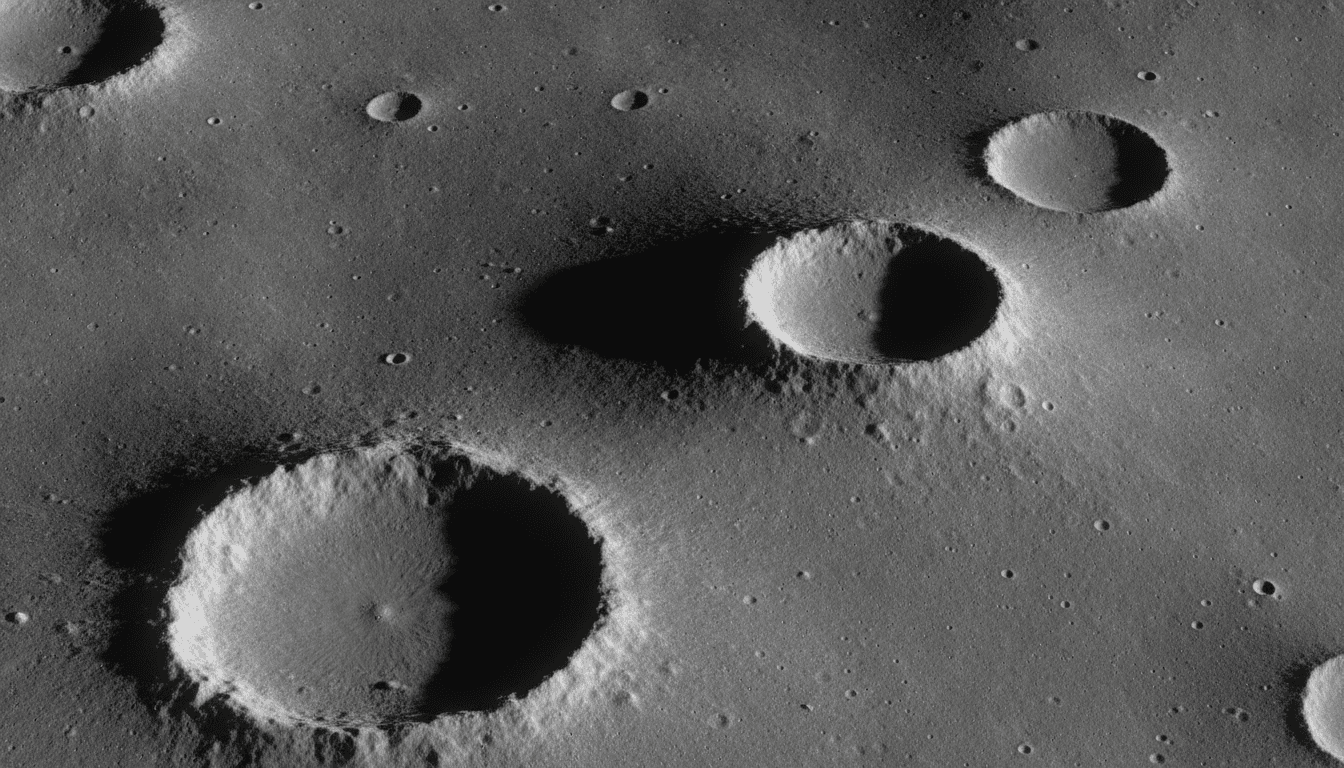
Earth rising over a cratered lunar horizon
The lunar library

Everything worth knowing about the Moon and its craters

We get asked the same wonderful questions in the shop every week. Here are the answers, with the numbers that make people go quiet.

1.3M+
Craters wider than one kilometre
5,185
Craters wider than twenty kilometres
~1,600
Craters that carry an official name
99.8%
Of lunar craters still unnamed
01

The Numbers

1,300,000+

More than 1.3 million craters wider than a kilometre

The most complete modern survey of the Moon, built from Lunar Reconnaissance Orbiter data, catalogued over 1.3 million impact craters at least one kilometre across. Nobody has counted the smaller ones. Below a kilometre the number runs into the billions.

craters wider than 1 km

5,185

Roughly 5,185 craters are wider than 20 kilometres

Twenty kilometres is about the size where a crater stops being a simple bowl and starts developing terraced walls and a central peak. There are a little over five thousand of those on the Moon.

craters wider than 20 km

99.8%

Only about 1,600 craters carry an official name

The International Astronomical Union has formally named roughly sixteen hundred lunar craters since Giovanni Riccioli began the modern naming convention in 1651. Set against 1.3 million catalogued craters, that means more than 99.8 percent of the Moon's craters have never been named by anyone.

of lunar craters are unnamed

02

Crater Science

Nothing on the Moon erases a crater

Earth loses its craters to rain, wind, plate tectonics, and vegetation. The Moon has none of these. With no atmosphere and no water, the only thing that erodes a lunar crater is another impact. A crater formed three billion years ago can still have a sharp rim today.

2,500 km

The largest crater is 2,500 kilometres across

The South Pole-Aitken basin on the far side spans about 2,500 kilometres and runs eight kilometres deep, making it one of the largest known impact structures anywhere in the solar system. It is so big that it was only properly recognised from orbit.

South Pole-Aitken basin

1,500 km

Tycho threw debris a quarter of the way around the Moon

Tycho is only about 108 million years old, young enough that dinosaurs on Earth could have watched it form. Its bright ray system stretches more than 1,500 kilometres, and at full moon those rays are visible from a Joshua Tree driveway with no equipment at all.

of Tycho ray debris

Craters are the reason we can date the solar system

Because impacts arrive at a roughly predictable rate, counting craters on a surface tells you how long that surface has been exposed. Crater counting is how planetary scientists date terrain on Mars, Mercury, and the moons of Jupiter.

03

Lunar Curiosities

3.8 cm

The Moon is drifting away at 3.8 centimetres a year

Tidal interaction is slowly pushing the Moon outward, about the rate your fingernails grow. In roughly 600 million years it will be too far away to fully cover the Sun, and total solar eclipses will end forever.

further away each year

29.5

A single lunar day lasts about 29.5 Earth days

The Moon rotates once per orbit, which is why the same face always points at us. Sunrise to sunrise at any point on the surface takes nearly a month, so a crater floor can bake at 120 degrees Celsius and then freeze to minus 170.

Earth days per lunar day

Moon dust smells like spent gunpowder

Apollo astronauts tracked regolith back into the lander and reported a distinct burnt smell once it hit the cabin air. Nobody has fully explained it. Samples returned to Earth lost the scent entirely.

The footprints will outlast every city on Earth

With no wind and no water, the boot prints left in Mare Tranquillitatis in 1969 will remain legible for millions of years, disturbed only by the slow rain of micrometeorites.

04

Observing

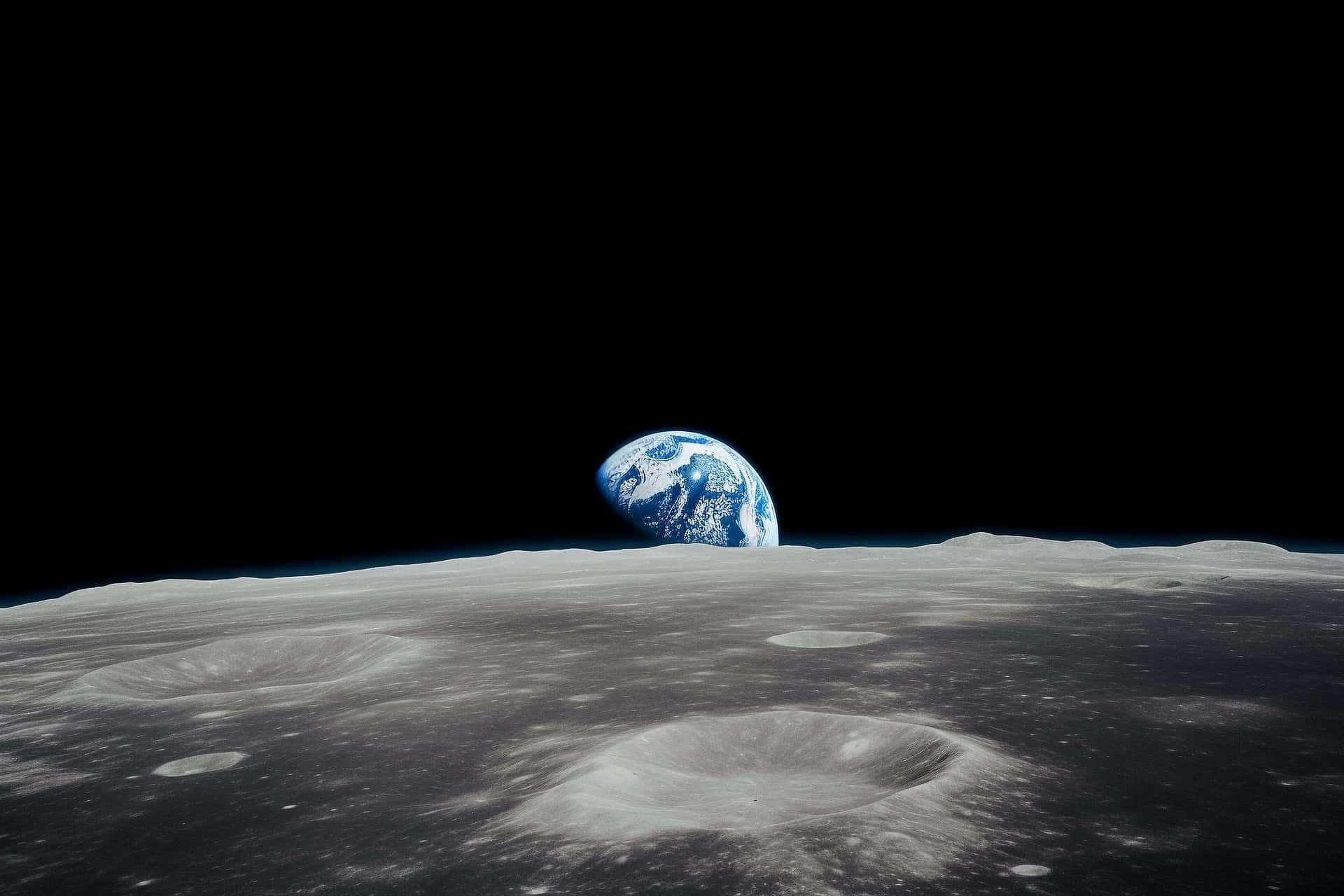
Craters look best at the terminator, never at full moon

The terminator is the line between lunar day and night. Along it the Sun sits low and every rim throws a long shadow, turning the surface three-dimensional. At full moon the light is straight on and the same craters flatten out and disappear.

Bortle 3-4

Joshua Tree sits under Bortle 3 and 4 skies

Joshua Tree National Park is one of the darkest accessible parks in Southern California, dark enough that the Milky Way casts a faint shadow on a moonless night. It became an International Dark Sky Park in 2017.

dark sky rating over the park

Binoculars are enough to start

A pair of 10x50 binoculars, braced against a car roof on Park Boulevard, will show you the major maria, the Apennine mountains, and the ray system around Tycho. Most people are surprised how much of the Moon they can find without a telescope.

Why so many are nameless

Naming the Moon was never finished

Giovanni Riccioli laid out the modern scheme in 1651, naming craters after philosophers and astronomers and christening the dark plains as seas. It was a beautiful system, and it was built for a Moon seen through a small refractor. Riccioli could resolve a few hundred features. He named what he could see.

Four centuries later, spacecraft have mapped the surface down to the metre. The International Astronomical Union has kept adding names, but deliberately slowly and only where science needs a label. The naming never caught up with the mapping, and it never will.

So the Moon sits there, fully charted and almost entirely anonymous. Well over a million craters, catalogued, measured, photographed from orbit, and nameless. That gap is where this company lives.

See the unnamed craters
Low sunlight raking across overlapping craters along the lunar terminator
Along the terminator, a crater rim can throw a shadow tens of kilometres long.
Made with Modulify